|
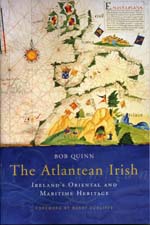
ATLANTEAN, in the Bob Quinn version, is not a fanciful tale of a submerged continent.
It is a pragmatic elucidation of Irish identity using much the same sources and scholarship that have been available for the past 2000 years to scholars and writers. The thesis is refreshing in that it states that the Irish are not a homogenous fiction called 'celtic' but an energetic mongrel people inhabiting what for thousands of years has essentially been an island trading post.
This brings them at least as close to the Arabs and Berbers as they are to so-called 'Celts' or 'Aryans'.
ATLANTEAN can be viewed as an anti-racist polemic but because the first edition was printed over 16 years ago - before Ireland became an uneasily cosmopolitan society - it is much more than that.
The basic principle is that the sea does not divide peoples - it unites all countries and all races.
The project began innocently enough when, twenty years ago, an Irish film maker, Bob Quinn, set out to show that the singing style of his neighbours in Gaelic-speaking Conamara in the West of Ireland was much more than a debased and incomprehensible version of ballad-singing - which was the attitude of anglophones. He showed how similar it was to North African and Afro-Asian singing and daringly went on to draw historic, religious, artistic, archaeological and linguistic similarities with Hamito-Semitic cultures
A trilogy of films ensued. They won prizes, were acclaimed internationally. The film maker wrote a book on the subject. The book has recently been revised, rewritten and published under the new title "Atlantean Irish: Ireland's Oriental and Maritime Heritage" (Lilliput Press, Dublin 2005)
Irish people who had an interest in maritime affairs - such as John de Courcy Ireland and Tim Severin - were delighted
'In megalithic times the Irish sea was bright with argonauts'
From the 9th century the Vikings ruled the waves
A thousand years later the pirate corsairs from North Africa maintained the tradition
Atlantean showed that the island of Ireland was never a remote outpost on the fringes of Europe. From the hunters and fishermen of the megalithic age to the investors and carpetbaggers of the modern age, from Eastern monks fleeing persecution to establishment clerics, from the Mediterranean to the Baltic, the island has always been regarded as a lucrative trading post and a desirable residence.
Traditional Irish musicians loved the idea, felt it endorsed their natural instinct to explore rhythms and harmonies hitherto considered un-Irish.
The response to the films and the book was intriguing:
Old fashioned academics maintained a public silence while privately attacking the thesis.
Serious scholars with imagination were pleased that a hitherto-repressed perspective on Ireland had seen the light of day - again.
The questioning nature of the Irish psyche has ensured that there is still a demand for the films and the book both at home and internationally.
The Atlantean Quartet of films is newly available on DVD, from this site
|